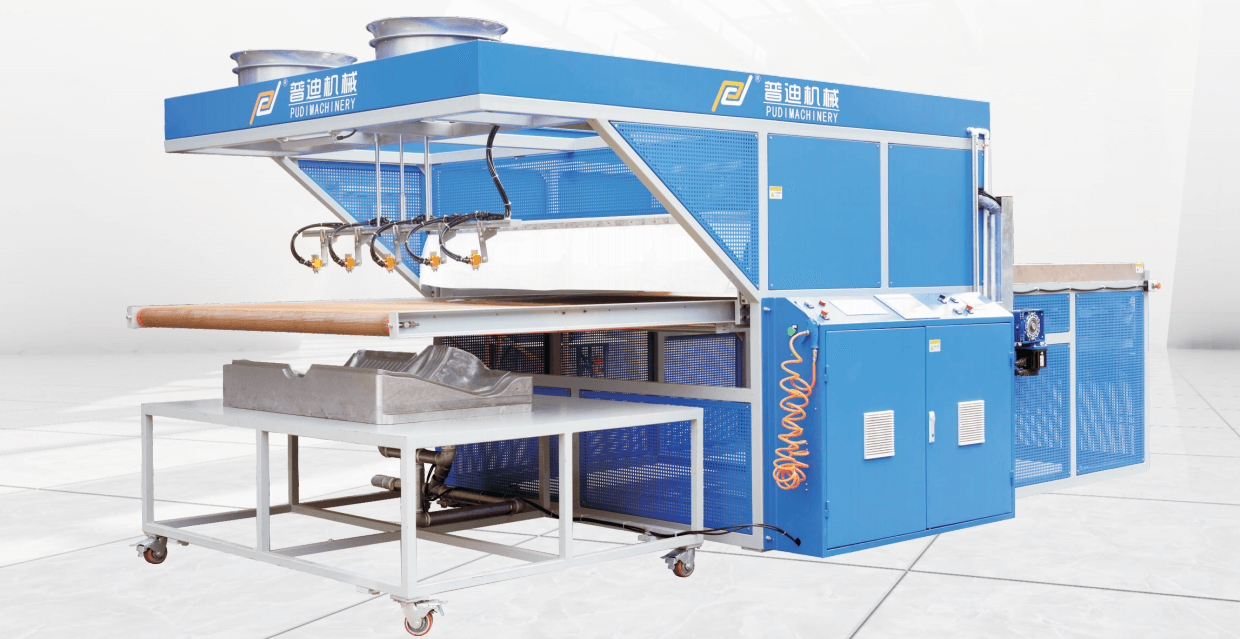
Automotive floor mats have a very different forming profile from many conventional thermoformed products.
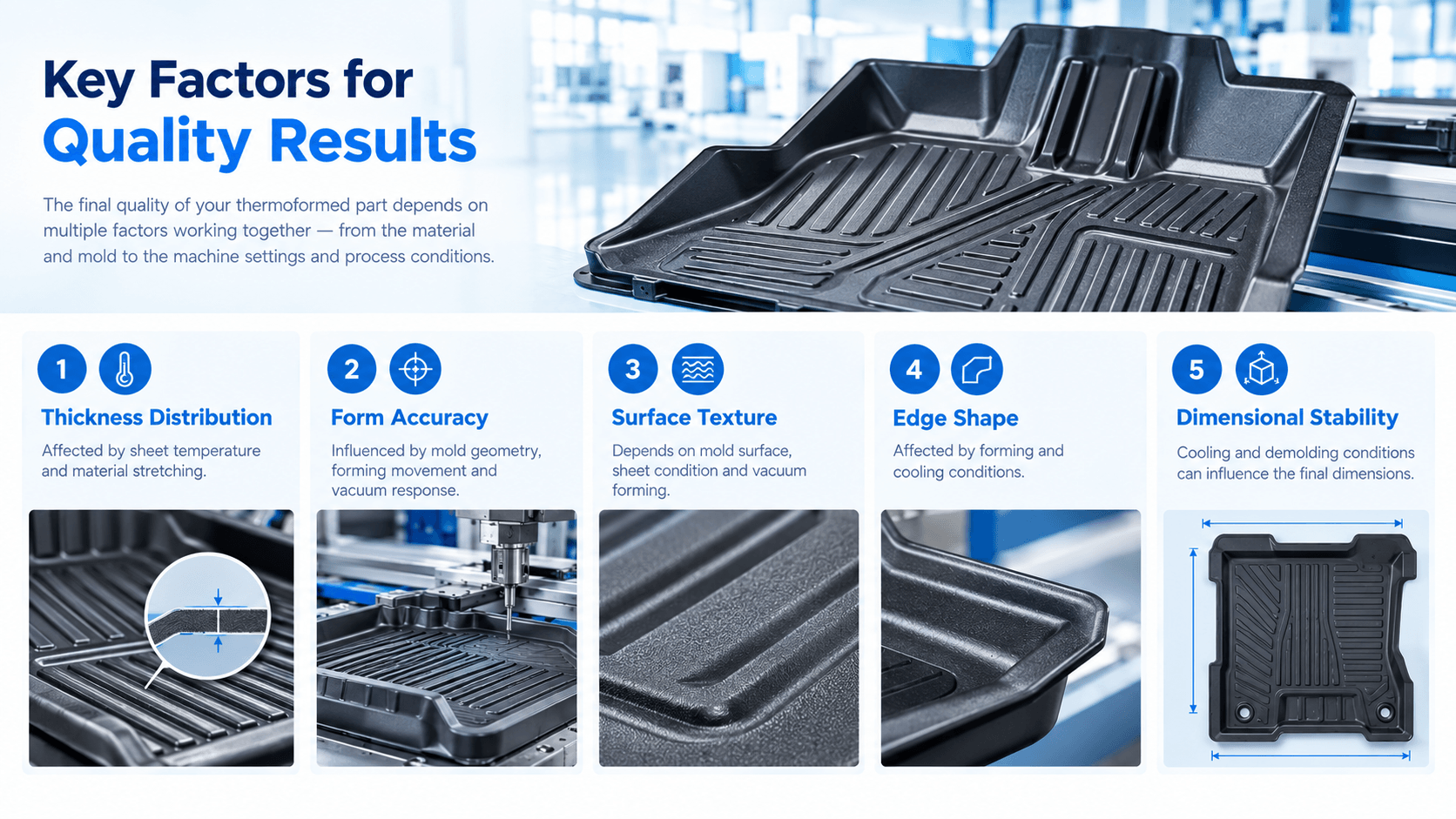
A single mat can combine deep contours, raised edges, grooves, textured surfaces and different forming depths. During forming, the heated sheet must stretch across these features while maintaining an acceptable material distribution.
The machine therefore needs to control the complete forming cycle — from sheet heating and positioning to vacuum application, cooling and demolding.
CN configures car mat thermoforming systems according to the actual product and mold rather than relying only on a standard machine size.
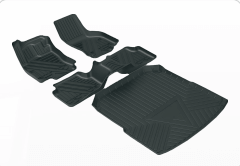
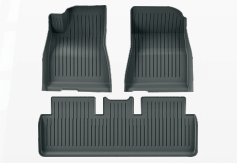
TPE is widely used for automotive floor mats because it combines flexibility with durability and can be formed into complex three-dimensional shapes.
The forming process must account for the way TPE stretches when heated. If the heating profile or forming conditions are not properly matched to the product, some areas may become excessively thin while other areas may not fully reproduce the mold.
CN thermoforming systems can be configured with controlled heating zones, vacuum forming and cooling according to the TPE sheet, mold geometry and required production cycle.
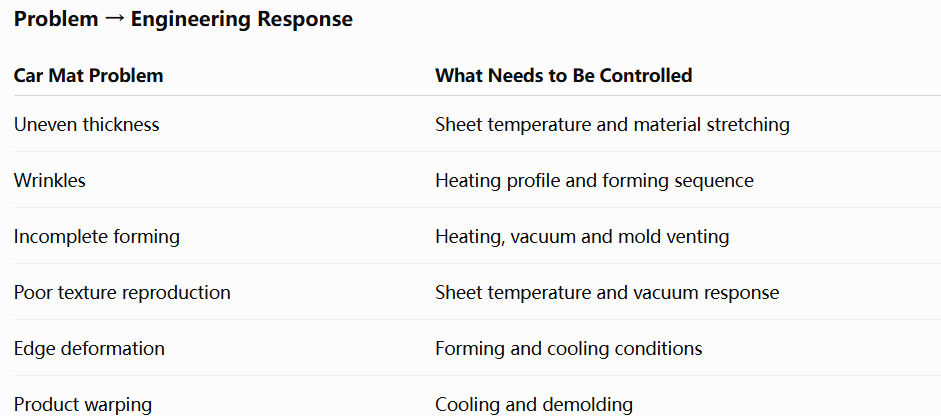
The thermoforming machine provides the forming process, but the mold determines much of the final product geometry.
For automotive mats, mold design should account for forming depth, draft angles, surface texture, vacuum venting, cooling and demolding.
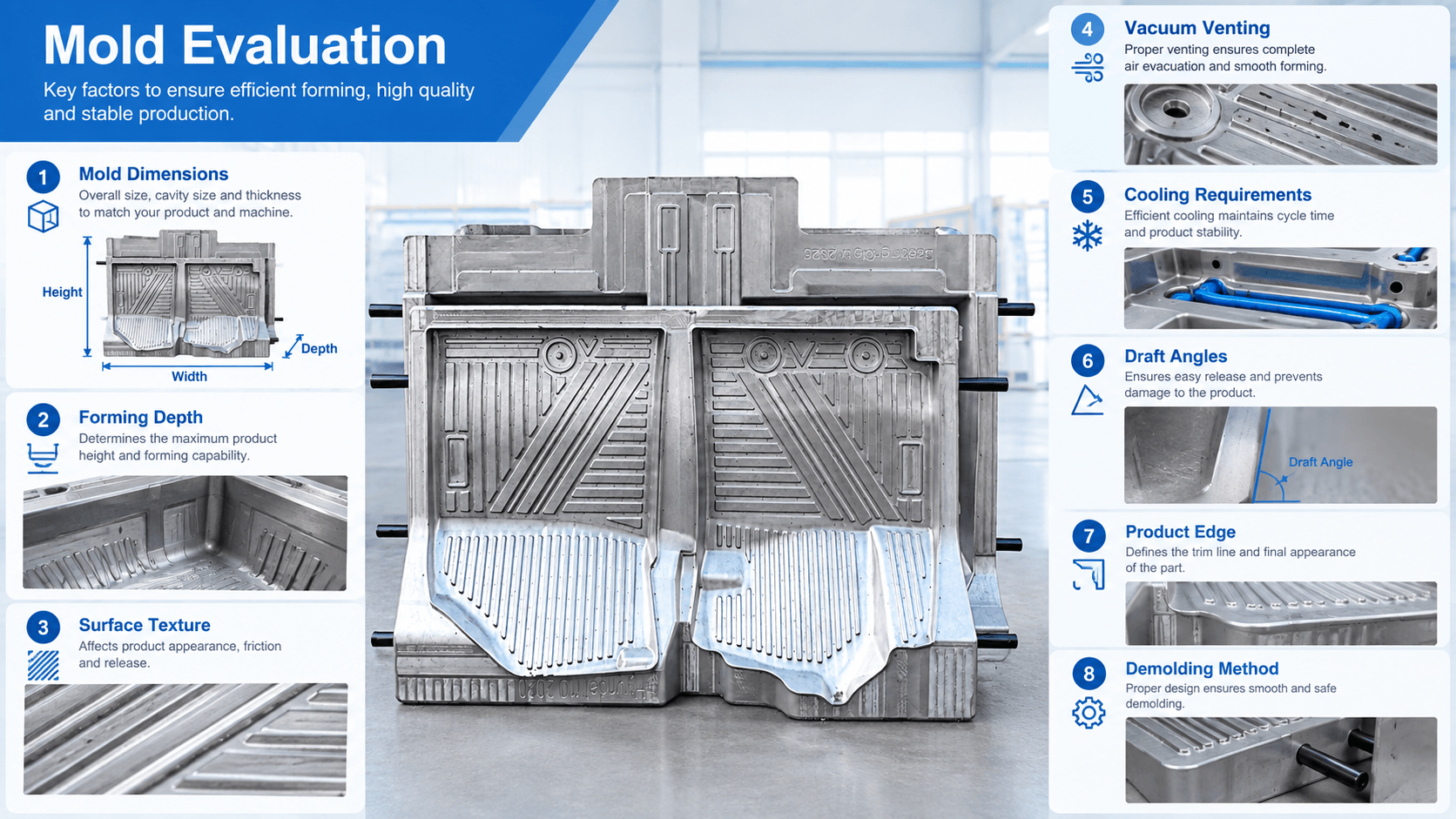
Car mats rarely have a uniform forming depth. Deep channels, raised edges and large flat sections can place different demands on the heated sheet.
Multi-zone heating allows the temperature profile to be adjusted according to the product geometry and material behavior.
Automotive mats often contain grooves, corners, raised edges and textured surfaces that require effective air evacuation from the mold cavity.
Vacuum performance therefore depends on the complete system, including pump capacity, vacuum lines, valves, mold venting and sealing.
For each project, these factors are considered together with the mold and product geometry.
| Specification | Configuration |
|---|---|
| Application | Automotive floor mats, trunk liners, cargo mats |
| Materials | TPE, TPO, PP and suitable thermoplastics |
| Sheet Thickness | Approx. 1–5 mm* |
| Forming Area | Up to approx. 3500 × 1500 mm* |
| Heating | Multi-zone heating |
| Forming Method | Vacuum forming |
| Drive System | Servo / application-specific |
| Control | PLC + HMI |
| Clamping | Automatic perimeter clamping |
| Cooling | Application-specific |
| Mold | Customer-supplied or project-specific |
| Automation | Optional |
*Actual specifications depend on material, product geometry, mold and production requirements.
CN machines can be configured for TPE, TPO, PP and other suitable thermoplastic sheet materials. Material compatibility depends on the sheet formulation, thickness and forming requirements.
Yes. The forming system can be configured for mats with raised edges, deep contours, grooves, textured surfaces and other three-dimensional features.
Yes, provided the products and molds fall within the machine's forming and process capabilities. Different production programs can be configured for different products.
Yes. Customer-supplied molds can be evaluated during the engineering stage.
Yes. Large-format configurations can be developed for trunk liners, cargo liners and other large automotive formed products.
Machine size is determined by the product dimensions, mold dimensions, sheet size, forming depth and production requirements.
A product drawing, 3D model or sample is the best starting point. Material, sheet thickness, mold information and expected production quantity are also useful.