A thermoforming heating system prepares thermoplastic sheet for forming by bringing the material into a controlled and repeatable temperature range.
The objective is not simply to make the plastic sheet hot. The heating system must provide the right temperature distribution across the sheet so that the material can form correctly without excessive thinning, incomplete forming, or dimensional variation.
This becomes particularly important when processing thick plastic sheet or large forming areas.
A well-designed thermoforming heating system is therefore built around:
Material → Sheet Thickness → Sheet Size → Heating Zones → Temperature Control → Forming Process
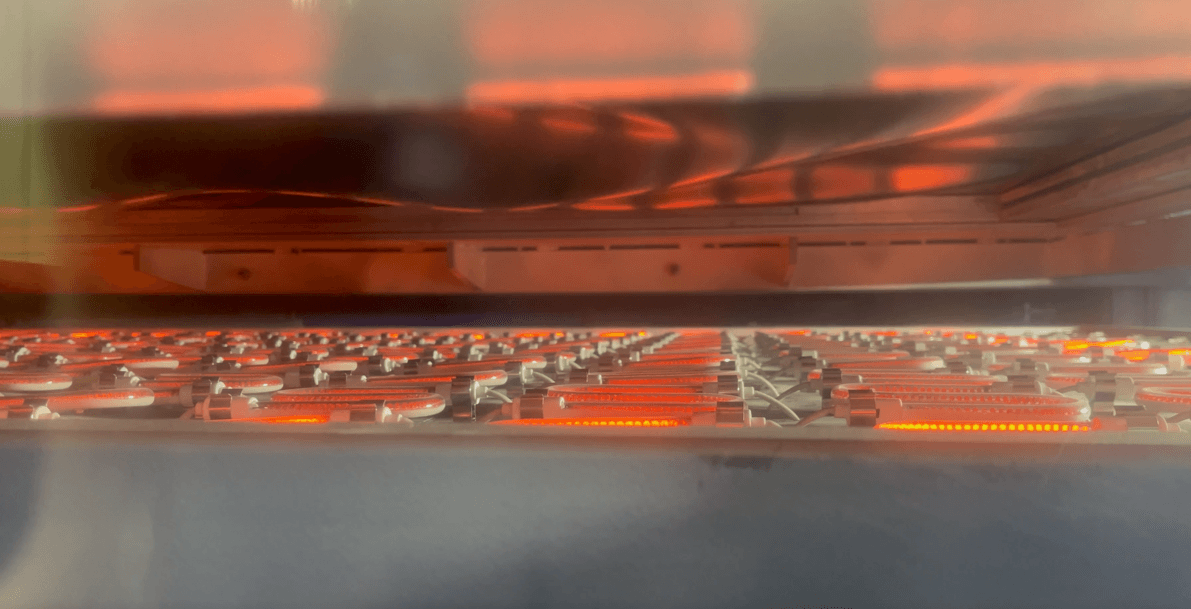
The heating system transfers thermal energy to the plastic sheet before forming.
A typical process is:
Sheet Loading → Heating → Temperature Stabilization → Forming
During heating, the sheet absorbs energy from the heating elements. Once the material reaches a suitable forming condition, it is transferred to the mold and formed using vacuum, pressure, mechanical movement, or a combination of methods.
The heating system must maintain a stable relationship between:
The correct settings depend on the material and application.
A heating profile that works for one plastic or sheet thickness may not produce the same result with another.
Temperature distribution across the sheet has a direct effect on forming quality.
If one area is significantly hotter than another, the hotter area may soften and stretch more easily. A cooler area may resist forming.
This can result in:
For this reason, thermoforming heating should be evaluated across the entire forming area rather than based on a single temperature measurement.
The objective is to create a controlled temperature profile, not necessarily to make every point of the sheet exactly the same temperature.
Multi-zone heating divides the heating area into independently controlled sections.
Instead of using one heating setting for the entire sheet, different zones can be adjusted according to the thermal requirements of the application.
A heating system may include separate zones for:
This is especially useful for large sheets where the edges may lose heat more quickly than the center.
It can also help compensate for differences caused by part geometry and material distribution.
A large or complex part does not necessarily require identical heating conditions everywhere.
For example, a region that will undergo significant stretching may require a different thermal condition from a relatively flat region.
Multi-zone control provides the flexibility to adjust the heating profile without changing the entire heating system.
Radiant heating technologies are widely used in thermoforming because they transfer thermal energy directly to the plastic sheet without physical contact.
Depending on the machine and application, thermoforming systems may use technologies such as:
The effectiveness of a heating element depends on more than its rated power.
The actual heating result is influenced by:
The heating system should therefore be designed around the complete thermoforming process rather than selected only by heater wattage.
Heating becomes more challenging as sheet thickness increases.
Heat must travel from the heated surface toward the center of the material. This means the surface can become hot while the core is still relatively cool.
A simplified temperature profile looks like:
Hot Surface → Outer Layer → Core → Outer Layer → Hot Surface
If the surface is heated too aggressively, the outside of the sheet may become excessively soft before the center reaches a suitable forming condition.
This can affect:
For thick-sheet applications, the heating system therefore needs to balance heating intensity and heating time rather than simply increasing heater power.
For more information, see our guide to Heavy Gauge Thermoforming.
Consistent thermoforming requires consistent sheet temperature.
Temperature control may involve:
Non-contact infrared measurement can be useful because the plastic sheet is hot and may be moving during the heating cycle.
However, the measured temperature can be affected by factors such as:
Temperature measurement should therefore be properly matched to the material and application.
The goal is not simply to display a temperature value. The goal is to use temperature information to maintain a repeatable forming condition.
Large-format thermoforming creates additional challenges for heating.
As sheet dimensions increase, maintaining uniform thermal conditions across the complete forming area becomes more difficult.
Potential differences can occur between:
Edge heat loss can be particularly important.
A properly configured multi-zone heating system can compensate for these differences by adjusting the energy supplied to individual areas.
For large parts, heating should also be considered together with vacuum distribution and cooling.
See also: Large Format Thermoforming.
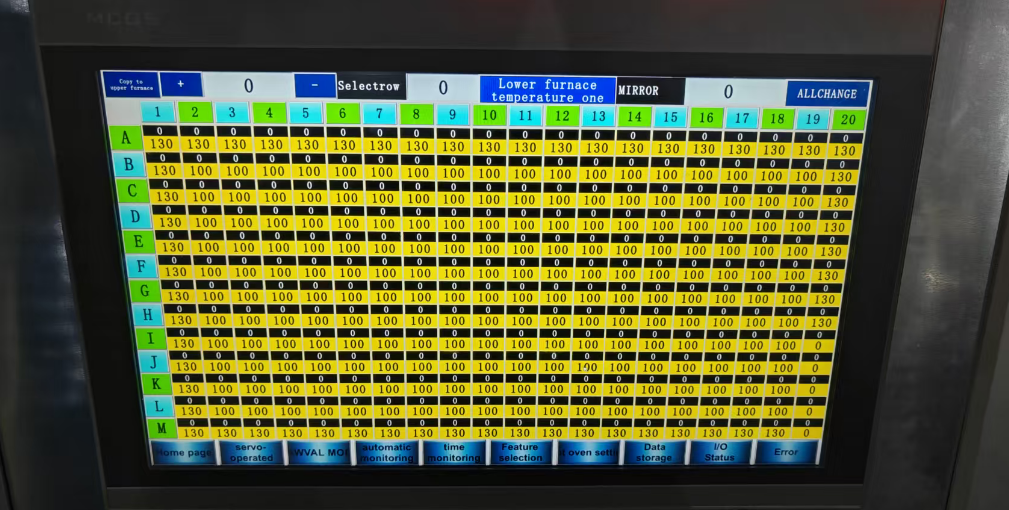
A thermoforming machine may store different heating recipes for different materials and products.
A recipe can include:
The correct recipe depends on the complete application.
A useful way to approach recipe development is:
Material → Sheet Thickness → Initial Heating → Temperature Measurement → Trial Forming → Adjustment
The process should then be repeated until a stable forming condition is established.
Once the heating profile is validated, it can be stored as part of the production recipe for repeatable operation.
Uneven heating can result from:
The result may be uneven stretching or localized thinning.
The first step is to compare the actual temperature distribution across the sheet before changing forming parameters.
This problem is particularly relevant to thick sheet.
The surface may appear ready for forming while the center remains cooler.
Increasing heater power may make the surface even hotter without solving the core-temperature problem.
The better approach may involve adjusting:
As plastic becomes softer, gravity can cause the sheet to sag before forming.
Excessive sag can affect material distribution and the starting position of the sheet relative to the mold.
Possible causes include:
The heating cycle should provide sufficient heat for forming without unnecessarily extending the time the softened sheet remains unsupported.
The edges of a large sheet can lose heat faster than the center.
This may cause the perimeter to form differently from the central area.
Multi-zone heating and edge compensation can help reduce this effect.
Heating development should begin with the actual product rather than a generic temperature setting.
Determine the polymer type, grade, sheet thickness, color, and relevant processing characteristics.
Identify deep areas, sharp transitions, large flat surfaces, and regions where material distribution is critical.
Set initial heating conditions based on the material, sheet thickness, and machine configuration.
Check temperature distribution across the sheet rather than relying on a single measurement point.
Evaluate:
Modify individual heating zones and cycle timing based on the actual forming results.
The objective is to establish a stable process window rather than one perfect temperature number.
For heavy gauge applications, heating must provide sufficient energy for heat penetration while avoiding excessive surface heating.
The main variables are:
Heating Power + Heating Time + Heater Position + Temperature Distribution + Forming Timing
The relationship between these variables becomes increasingly important as sheet thickness increases.
A suitable heating system should therefore be matched to the material and sheet thickness before the forming process is finalized.
See also: Heavy Gauge Thermoforming.
Large-format thermoforming requires consistent heating across a larger area.
The heating system should consider:
The larger the sheet, the more important it becomes to control temperature differences across the forming area.
This is one reason heating, vacuum, mold design, and cooling should be developed as an integrated process.
Heating efficiency is not simply about reducing heater power.
If power is reduced too far, the heating cycle may become longer or the sheet may not reach a stable forming condition.
A better approach is to optimize:
Energy Input → Heating Time → Sheet Temperature → Forming Quality
Potential areas for improvement include:
The goal is to supply the required thermal energy without unnecessary heating.
It heats thermoplastic sheet to a controlled forming condition before the sheet is shaped over or into a mold.
Uneven temperature distribution can cause uneven stretching, localized thinning, incomplete forming, and dimensional variation.
Multiple zones allow different areas of the sheet to receive different amounts of thermal energy, helping compensate for edge heat loss and differences in part geometry.
Infrared, ceramic, quartz, halogen, and other radiant heating technologies may be used depending on the material, sheet thickness, machine configuration, and production requirements.
Heat must penetrate farther through the material. The surface can become hot before the core reaches a suitable forming condition.
The process normally starts with the material and sheet thickness, followed by heating-zone setup, temperature measurement, trial forming, and adjustment of the heating profile.
A thermoforming heating system is not simply a group of heating elements.
Its purpose is to create a stable and repeatable thermal condition that allows the plastic sheet to form correctly.
The right heating strategy depends on:
Material → Sheet Thickness → Sheet Size → Product Geometry → Mold → Forming Process
For thick and large plastic parts, multi-zone heating, controlled temperature measurement, and a properly developed heating profile can make a significant difference in forming consistency.
Explore the related thermoforming engineering topics:
Heavy Gauge Thermoforming · Large Format Thermoforming · Thermoforming Vacuum System · Thermoforming Mold Design · Thermoforming Materials · Thermoforming Machine