The automotive accessories industry is undergoing a major transformation driven by automation and smart manufacturing technologies. Car mat production, once heavily reliant on manual labor, is now increasingly powered by automated systems that improve efficiency, reduce costs, and ensure consistent product quality.
Automation equipment in car mat factories plays a crucial role in streamlining operations—from material handling and forming to trimming, inspection, and packaging. This article provides an in-depth look at the types of automation equipment used, their benefits, cost implications, and how they contribute to modern, high-performance manufacturing environments.
Automation refers to the use of machines, control systems, and technology to perform tasks with minimal human intervention. In car mat factories, automation is applied across the entire production process to improve speed, accuracy, and scalability.
Factories that adopt automation gain a significant advantage in terms of productivity and profitability.
Automation can be implemented at different stages of the production process:
Each stage benefits from specific automation equipment designed to optimize performance.
These systems feed plastic sheets (PVC, TPE) into forming machines without manual intervention.
Benefits:
Conveyors transport materials and semi-finished products between different stages of production.
Types:
Advantages:
Industrial robots handle the loading of raw materials and unloading of finished products.
Key Features:
Modern vacuum forming machines are equipped with automation features such as:
Impact:
Advanced thermoforming systems include:
These features improve precision and reduce production downtime.
Injection molding machines often integrate:
This ensures high repeatability and minimal defects.
Computer Numerical Control (CNC) machines are widely used for precise cutting of car mats.
Advantages:
Robotic arms equipped with cutting tools can trim edges and remove excess material.
Benefits:
Hydraulic presses can be automated with:
Camera-based systems inspect car mats for defects such as:
Benefits:
Sensors and laser measurement tools ensure that each mat meets design specifications.
Modern factories use software systems to collect and analyze production data.
Key Functions:
These machines handle:
Advantages:
Robots stack packaged mats onto pallets for shipping.
Automated storage and retrieval systems (AS/RS) improve inventory management and logistics efficiency.
Automation enables continuous operation and faster production cycles.
Machines ensure consistent results, reducing defects and variability.
Automated systems reduce the need for manual labor, lowering long-term costs.
Automation minimizes human involvement in hazardous processes.
Automated systems can be expanded easily to meet growing demand.
| Equipment Type | Cost Range |
|---|---|
| Automated Vacuum Forming | $60,000 – $150,000 |
| CNC Cutting Machine | $10,000 – $50,000 |
| Robotic Arm | $15,000 – $80,000 |
| Vision Inspection System | $5,000 – $30,000 |
| Packaging Automation | $5,000 – $40,000 |
Although automation requires higher initial investment, it offers:
ROI is typically achieved within 6–18 months depending on production scale.
Automation equipment can be expensive, especially for small businesses.
Requires skilled operators and technicians.
Regular maintenance is necessary to ensure optimal performance.
Combining different machines into a seamless production line can be challenging.
Smart factories use IoT and AI for real-time monitoring and control.
Cobots work alongside humans, improving flexibility and safety.
New systems focus on reducing energy consumption and environmental impact.
Automation systems are becoming more adaptable to different product designs.
Identify bottlenecks and labor-intensive processes.
Set clear objectives such as cost reduction or quality improvement.
Select machines that match your production needs and budget.
Ensure smooth workflow between machines.
Provide training for operators and technicians.
Use data analytics to optimize operations.
Automation equipment is transforming car mat manufacturing by improving efficiency, quality, and profitability. From material handling and forming to cutting, inspection, and packaging, automation plays a vital role in modern production lines.
While the initial investment may be significant, the long-term benefits—including reduced labor costs, higher productivity, and consistent product quality—make automation a strategic choice for manufacturers aiming to stay competitive in the global market.
By carefully selecting and implementing automation equipment, car mat factories can achieve sustainable growth and position themselves for success in an increasingly technology-driven industry.
The automotive accessories industry has experienced rapid growth in recent years, with car mats becoming an essential product for both functionality and aesthetics. Among the various manufacturing methods available, vacuum forming has emerged as one of the most efficient and cost-effective technologies for producing high-quality car mats. A vacuum forming machine for car mats enables manufacturers to achieve precision, consistency, and scalability while maintaining competitive production costs.
This article explores vacuum forming machines in detail, including their working principles, components, advantages, cost considerations, and how they fit into modern car mat production lines.
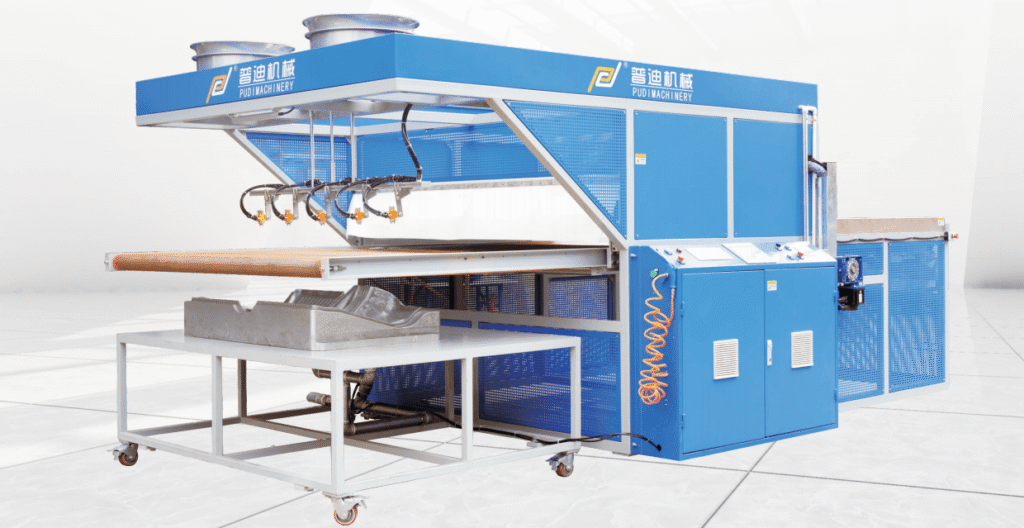
A vacuum forming machine is a type of thermoforming equipment that shapes heated plastic sheets into specific forms using vacuum pressure. In the context of car mat production, it is primarily used to create custom-fit mats with detailed contours that match vehicle floor designs.
The process involves heating a plastic sheet—commonly PVC, TPE, or similar materials—until it becomes pliable. The softened sheet is then placed over a mold, and a vacuum is applied to remove air between the sheet and the mold surface. This pressure difference forces the material to conform precisely to the mold shape.
Vacuum forming is widely used for manufacturing:
Its simplicity and efficiency make it a preferred choice for manufacturers aiming for high-volume production.
The vacuum forming process consists of several key steps:
Plastic sheets are selected based on product requirements. Common materials include:
The thickness of the sheet typically ranges from 2 mm to 5 mm, depending on the desired strength and flexibility.
The plastic sheet is clamped into a frame and heated using infrared or ceramic heaters. The temperature is carefully controlled to ensure uniform softening without degrading the material.
Once heated, the sheet is moved over a mold. A vacuum pump removes air between the sheet and the mold, causing the material to tightly conform to the mold’s surface. This step determines the final shape and detail of the car mat.
After forming, the material is cooled using air or water cooling systems. Cooling solidifies the shape and ensures dimensional stability.
Excess material is trimmed using cutting machines or CNC routers. Edges are smoothed, and additional processes such as embossing or logo printing may be applied.
A modern vacuum forming machine for car mats consists of several critical components:
The heating system ensures uniform temperature distribution across the plastic sheet. Advanced machines use multi-zone heating to control different areas independently, improving forming precision.
The vacuum pump is responsible for creating negative pressure. High-performance pumps ensure fast and consistent forming, especially for complex mold designs.
This component holds the plastic sheet securely during heating and forming. Strong clamping prevents material sagging or misalignment.
Molds are typically made from aluminum or steel and define the final shape of the car mat. High-quality molds are essential for achieving detailed textures and precise dimensions.
Modern machines are equipped with PLC (Programmable Logic Controller) systems and touch-screen interfaces. These allow operators to control temperature, vacuum pressure, and cycle time with precision.
Efficient cooling systems reduce cycle time and improve productivity. They also help maintain consistent product quality.
These machines require significant operator involvement. They are suitable for small-scale production or prototyping but are less efficient for mass manufacturing.
Semi-automatic machines automate key processes such as heating and vacuum application while still requiring manual loading and unloading. They offer a balance between cost and productivity.
Fully automated systems handle the entire process, including feeding, forming, cutting, and stacking. These machines are ideal for large-scale production and offer the highest efficiency and consistency.
Vacuum forming offers several advantages compared to other manufacturing methods:
Vacuum forming machines are generally less expensive than injection molding systems. Tooling costs are also lower, making it an attractive option for manufacturers with limited budgets.
Short cycle times enable high-volume production. This is particularly important for meeting market demand.
Manufacturers can easily modify molds to produce different designs, allowing customization for various vehicle models.
The process generates minimal waste, as excess material can often be recycled.
Vacuum-formed car mats are lightweight yet durable, improving handling and reducing shipping costs.
Understanding the cost structure is essential for investment decisions.
Molds can range from $2,000 to $20,000 depending on complexity and material.
Key operating costs include:
The cost per car mat can range from $1.5 to $5 depending on material, design, and production scale.
A vacuum forming machine is typically part of a larger production line that includes:
Automation of the entire line improves efficiency and reduces labor costs.
Proper maintenance ensures long-term performance and reliability:
Training operators is equally important to prevent errors and maximize productivity.
While primarily used for car mats, vacuum forming machines are versatile and can produce:
This versatility increases the return on investment for manufacturers.
The industry is evolving with new innovations:
Robotic systems are being integrated for material handling and trimming, reducing labor costs.
New machines are designed to consume less energy, lowering operating costs and environmental impact.
IoT-enabled machines allow real-time monitoring and predictive maintenance, improving efficiency.
The use of recyclable and biodegradable materials is increasing, driven by environmental regulations and consumer demand.
When selecting a machine, manufacturers should consider:
A well-chosen machine can significantly impact production efficiency and profitability.
Vacuum forming machines play a critical role in modern car mat manufacturing. They offer a cost-effective, flexible, and efficient solution for producing high-quality automotive mats at scale. By understanding the technology, cost structure, and operational requirements, manufacturers can make informed decisions that enhance productivity and profitability.
As the automotive industry continues to grow, the demand for durable, customizable, and eco-friendly car mats will increase. Vacuum forming technology, with its adaptability and efficiency, is well-positioned to meet these evolving needs.
Investing in the right vacuum forming machine, combined with proper maintenance and optimized production processes, can provide a strong competitive advantage in the global market.
In today’s automotive accessories market, car mats have become more than a functional item—they reflect style, comfort, and quality for vehicle owners. As demand grows, manufacturers must evaluate the costs associated with producing car mats efficiently. Understanding the cost structure of car mat machines and production lines is crucial for maximizing profitability, minimizing waste, and ensuring consistent quality. This article provides a comprehensive cost analysis, covering machine types, production processes, material considerations, labor, maintenance, and long-term financial planning.
Car mats are produced using several manufacturing methods, including injection molding, thermoforming, and stamping. The choice of method affects production efficiency, cost, and product quality.
Each machine type involves unique cost components that impact overall production line economics.
A complete car mat production line typically includes:
Understanding the functions and cost implications of each component helps in evaluating the total investment required.
The overall cost of a car mat production line can be divided into several categories:
Capital expenditure refers to the upfront cost of purchasing machines, tools, and equipment. For car mat production, major CapEx items include:
Investments should account for optional add-ons, such as robotic arms, multi-station forming units, or advanced heating and cooling systems.
Operating expenses include recurring costs for materials, labor, energy, maintenance, and factory overhead.
1. Raw Materials:
Car mats can be manufactured using various materials, each with different costs:
Material costs typically represent 40–60% of the total production cost, depending on product type and volume.
2. Labor Costs:
Labor includes machine operators, maintenance staff, and quality inspectors. Automation reduces labor costs but increases initial CapEx. Typical labor costs per machine range from $500 to $2,000 per month in emerging markets, and significantly higher in developed regions.
3. Energy Consumption:
Thermoforming and injection molding machines require substantial electricity for heating and molding. Energy costs depend on machine capacity, production speed, and local electricity rates. For instance, a medium-sized thermoforming line may consume 20–40 kWh per hour, translating into $50–$150 daily, depending on local rates.
4. Maintenance and Repairs:
Regular maintenance ensures high production efficiency and extends machine life. Annual maintenance is usually 5–10% of CapEx. For example, a $100,000 thermoforming line may require $5,000–$10,000 annually for upkeep, spare parts, and technical support.
Thermoforming lines are highly popular for large, custom-shaped car mats. A typical cost breakdown is:
| Component | Estimated Cost (USD) |
|---|---|
| Thermoforming Machine | $50,000–$120,000 |
| Trimming & Cutting System | $10,000–$30,000 |
| Embossing/Printing Unit | $15,000–$35,000 |
| Quality Inspection Equipment | $5,000–$15,000 |
| Packaging (Blister/Shrink) | $5,000–$20,000 |
| Total CapEx | $85,000–$220,000 |
Operating costs per 1,000 mats:
| Cost Category | Estimated Cost |
|---|---|
| Material | $1,200–$3,500 |
| Labor | $500–$1,500 |
| Energy | $100–$300 |
| Maintenance | $50–$200 |
| Total OpEx | $1,850–$5,500 |
Injection molding is ideal for rubber or TPE mats with complex textures. Typical costs include:
| Component | Estimated Cost (USD) |
|---|---|
| Injection Molding Machine | $40,000–$150,000 |
| Mold Tooling | $10,000–$50,000 per mold |
| Cutting & Finishing | $10,000–$25,000 |
| Packaging | $5,000–$15,000 |
| Total CapEx | $65,000–$240,000 |
Operating costs per 1,000 mats:
| Cost Category | Estimated Cost |
|---|---|
| Material | $1,500–$4,000 |
| Labor | $400–$1,200 |
| Energy | $150–$400 |
| Maintenance | $100–$300 |
| Total OpEx | $2,150–$5,900 |
Blister packaging enhances product appeal and reduces shipping damage. Costs for this stage:
| Component | Estimated Cost (USD) |
|---|---|
| Blister Packaging Machine | $5,000–$30,000 |
| Film/Plastic Sheets | $200–$1,000 per 1,000 units |
| Labor | $100–$400 |
| Energy | $20–$50 |
| Maintenance | $50–$100 |
| Total OpEx | $370–$1,550 |
Several factors influence the cost efficiency of car mat production lines:
Higher volumes reduce per-unit costs due to economies of scale. A line producing 5,000 mats per month will have lower cost per unit than a line producing 500 mats.
Premium materials increase durability but raise material costs. PVC is cheaper but less durable than rubber or TPE.
Automated lines reduce labor costs and improve consistency but increase initial CapEx. Semi-automatic lines are more affordable but require higher manual labor.
Efficient machines with low energy consumption and minimal downtime reduce overall production costs.
Labor rates, electricity costs, and import duties for machines and raw materials impact total cost. Manufacturing in low-cost regions may improve profitability.
Investing in car mat machines requires evaluating not just initial costs but also the entire lifecycle:
A lifecycle cost analysis ensures long-term profitability and sustainable operations.
ROI is a key metric for evaluating production line investment. It considers initial CapEx, operating costs, and revenue from sales. For example:
Such analysis helps manufacturers plan production scale and pricing strategies.
Cost analysis of car mat machines and production lines requires a holistic approach, considering CapEx, OpEx, material selection, labor, energy, and maintenance. By understanding these cost components and evaluating machine types—thermoforming, injection molding, and blister packaging—manufacturers can make informed investment decisions. Proper planning ensures not only high-quality car mats but also sustainable profitability, faster ROI, and competitive advantages in the growing automotive accessories market.
A strategic approach to cost management, combined with modern machinery and automation, can significantly enhance production efficiency and market responsiveness, making it essential for both new entrants and established car mat manufacturers.
In the competitive automotive accessories market, choosing the right car mat machine is critical for manufacturers. Production volume, material type, and automation requirements all affect the final decision. Car mat machines are generally divided into three categories: manual, semi-automatic, and fully automatic. Each type has distinct advantages, limitations, and ideal applications. Understanding these differences helps manufacturers optimize workflow, reduce costs, and maintain high-quality output.
Manual machines are the simplest option and are ideal for small workshops or startups. Operators handle most tasks, including material loading, molding, and trimming.
Key Features:
Advantages:
Limitations:
Manual machines are suitable for small-scale or custom mat production, where volume is not a primary concern.
Semi-automatic machines offer a balance between efficiency and cost. Certain processes, such as heating and molding, are automated, while operator intervention is still required for tasks like loading and unloading.
Key Features:
Advantages:
Limitations:
Semi-automatic machines are commonly used in factories producing mid-volume batches where a combination of automation and manual handling is effective.
Fully automatic machines are designed for large-scale production. They integrate all stages of car mat manufacturing into a single, continuous workflow.
Key Features:
Advantages:
Limitations:
Fully automatic machines are ideal for manufacturers producing large volumes, OEM clients, or premium mats requiring high precision.
Different materials require machines with suitable forming and trimming capabilities:
Choosing the right machine for your material ensures product consistency and reduces waste.
When deciding between manual, semi-automatic, or fully automatic machines, consider:
Understanding the differences between manual, semi-automatic, and fully automatic car mat machines is essential for any manufacturer. Small workshops benefit from manual machines, medium-scale factories thrive with semi-automatic machines, and large-scale production demands fully automatic systems. By selecting the right type, manufacturers can optimize production, reduce labor costs, and maintain high-quality output.
➡ For expert advice on choosing the perfect car mat machine for your factory, contact our team today and get tailored recommendations.
Selecting the right car mat machine is a critical decision for manufacturers. The wrong choice can lead to low productivity, wasted materials, and high operational costs. Factors such as production volume, material type, automation level, and budget must be carefully evaluated. This guide provides a step-by-step approach to choosing the ideal car mat machine for your factory.
Estimate your daily or monthly production targets. Manual machines are suitable for low volumes, semi-automatic machines for medium-scale production, and fully automatic machines for high-volume factories.
Identify the types of mats you plan to produce: PVC, TPE, rubber, or carpet. Machines vary in their ability to handle different materials. For example, TPE mats require precise forming and often fully automatic machines.
Higher automation reduces labor costs and improves consistency but increases initial investment. Balance your budget with long-term efficiency.
Reliable after-sales service and easy-to-maintain equipment reduce downtime and production losses. Check if the supplier offers spare parts and technical guidance.
Choose a machine that can integrate into a full production line, allowing you to expand output or add new mat designs in the future.
Selecting the right car mat machine is a strategic decision that affects your factory’s efficiency, product quality, and profitability. Assess production needs, material compatibility, automation, and support before investing.
➡ Contact our experts today to find the best car mat machine for your manufacturing requirements.
Car mat manufacturing has evolved significantly with the adoption of thermoforming technology. A car mat thermoforming machine allows manufacturers to produce durable, customized, and high-quality automotive floor mats efficiently. This guide explains how these machines work, their advantages, types, materials used, production process, and how to choose the right machine for your factory.
A car mat thermoforming machine is an industrial machine designed to heat plastic sheets and form them into automotive floor mats using molds and vacuum or pressure forming technology.
During the process:
The result is a precisely shaped, durable automotive floor mat ready for finishing.
Thermoforming has become the preferred manufacturing method for car mats because it offers several advantages.
Thermoforming machines can produce large quantities of mats in a short time, making them ideal for automotive supply chains.
Precision molds ensure that every mat maintains the same dimensions, patterns, and edges.
Various thermoplastic materials can be used, allowing manufacturers to produce mats with different textures, thicknesses, and performance characteristics.
Compared with injection molding, thermoforming requires less tooling cost and energy consumption.
Manufacturers can create mats tailored for specific car models with logos, anti-slip patterns, and raised edges.
Car mat thermoforming machines are used to manufacture different types of automotive mats.
PVC mats are durable, waterproof, and easy to clean. They are commonly used in entry-level and mid-range vehicles.
TPE mats are flexible, environmentally friendly, and resistant to temperature extremes. Many modern automotive brands prefer TPE for premium mats.
These mats provide high traction and are ideal for off-road vehicles or regions with heavy rain and snow.
These mats have raised edges and custom contours that match specific vehicle floor designs.
Understanding the components helps manufacturers evaluate machine performance and reliability.
Automatically feeds thermoplastic sheets into the forming area.
Infrared or ceramic heaters evenly heat the plastic sheet to its forming temperature.
The heated sheet is shaped using vacuum, pressure, or mechanical forming molds.
Ensures the formed mat solidifies while maintaining the desired shape.
Removes excess material and defines the final mat shape.
Modern machines use PLC control panels for automation, temperature control, and cycle timing.
The manufacturing process typically includes several stages.
Plastic sheets such as PVC or TPE are prepared in the required thickness.
The sheet enters the heating station where it becomes soft and moldable.
The heated sheet is formed over the car mat mold using vacuum or pressure.
Cooling stabilizes the product and prevents deformation.
CNC or hydraulic cutting systems trim the formed mats to their final dimensions.
Finished mats are checked for shape accuracy, thickness consistency, and surface quality.
Selecting the right material affects durability, cost, and environmental performance.
When selecting a machine, manufacturers should evaluate several critical factors.
The forming area determines how many mats can be produced in each cycle.
Advanced heating systems provide uniform heat distribution and reduce energy consumption.
Fully automatic machines reduce labor costs and increase production efficiency.
A machine should allow easy mold changes to produce mats for different car models.
Cycle time directly affects manufacturing output.
Ensure the machine supports the materials you intend to process.
Modern car mat thermoforming machines often include full automation.
Benefits include:
Automation is especially valuable for factories supplying automotive OEMs.
Car mat thermoforming machines are used across various sectors.
Manufacturers producing mats for new vehicles.
Companies selling universal or custom mats for retail markets.
Businesses creating premium interior accessories.
Factories producing mats for international distribution.
Regular maintenance ensures machine longevity and stable production.
Recommended maintenance practices:
Preventive maintenance minimizes downtime and production losses.
Selecting the right supplier is just as important as selecting the machine itself.
Consider the following:
Reliable suppliers provide long-term technical support and help optimize production efficiency.
The thermoforming industry continues to evolve with new technologies.
Integration with Industry 4.0 systems enables real-time monitoring and data analysis.
New heating technologies reduce power consumption.
Growing demand for recyclable and biodegradable materials.
High-speed forming systems improve productivity for large-scale automotive suppliers.
A car mat thermoforming machine plays a critical role in modern automotive accessory manufacturing. With high efficiency, flexible material options, and precise forming capabilities, thermoforming technology enables manufacturers to produce durable and customized car floor mats at scale.
By understanding the machine components, materials, and production process, manufacturers can choose the right equipment to improve productivity, reduce costs, and meet the growing demand for high-quality automotive interior products.