A thermoforming vacuum system removes air between the heated plastic sheet and the mold so the sheet can conform to the mold surface.
Vacuum performance has a direct effect on forming quality, especially when producing large, deep, or complex plastic parts.
A good thermoforming vacuum system should provide sufficient vacuum capacity and fast air removal while working together with the mold and its venting system.
The basic relationship is:
Mold → Venting → Vacuum Piping → Vacuum Pump
Each part of the system affects forming performance.
The basic thermoforming process is:
Heat the Sheet → Position the Sheet → Apply Vacuum → Form the Part → Cool
After the heated plastic sheet is positioned over the mold, the vacuum system removes air from the space between the sheet and mold.
As the air is removed, atmospheric pressure pushes the softened sheet against the mold surface.
The faster and more evenly the air can be removed, the more effectively the sheet can conform to the mold.
This is particularly important for parts with deep cavities or detailed surfaces.
Vacuum is responsible for helping the heated plastic sheet follow the mold geometry.
Poor vacuum performance can result in:
However, vacuum performance is not determined by the pump alone.
The pump, piping, valves, mold venting, sealing, and forming area all work together.
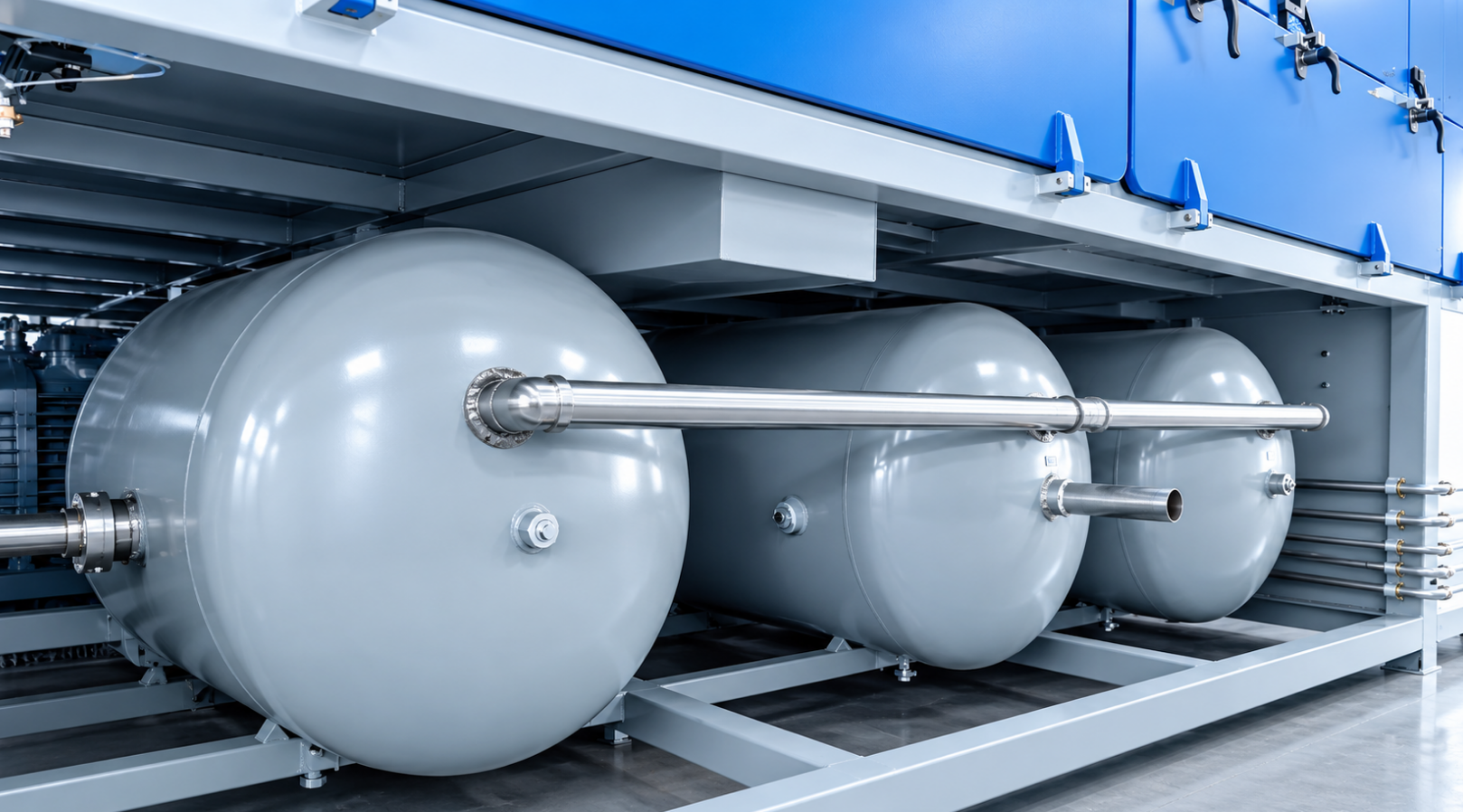
Vacuum pump capacity is one of the most important factors when designing a thermoforming system.
The required capacity depends on the application.
Important factors include:
A small and shallow part may require relatively little vacuum capacity.
A large mold with deep cavities can contain much more air and may require a higher-capacity system.
For this reason, there is no single vacuum pump specification that is suitable for every thermoforming machine.
The pump should be selected according to the actual mold and production requirements.
Maximum vacuum level is important, but it is not the only consideration.
For thermoforming, vacuum speed can be equally important.
The heated sheet has a limited forming window. If the vacuum develops too slowly, the plastic may begin to cool before it completely contacts the mold.
This can affect:
A well-designed vacuum system should therefore remove air quickly enough for the sheet to form while it is still at the appropriate temperature.
Mold venting allows trapped air to escape from the mold surface.
Vent holes are often required in areas such as:
Without sufficient venting, air can remain trapped between the plastic sheet and mold.
Increasing pump capacity does not always solve this problem.
If the air cannot travel efficiently from the mold surface to the vacuum system, even a powerful vacuum pump may not provide the expected forming result.
This is why vacuum system and mold design should be considered together.
See also: Thermoforming Mold Design.
Large-format thermoforming creates additional demands on the vacuum system.
A large mold may have:
The system must remove air efficiently across the complete forming area.
For large parts, the design may include multiple vacuum connections or carefully arranged vacuum channels to improve air removal.
The goal is not simply to achieve a high vacuum reading.
The goal is to achieve fast and consistent forming across the entire mold.
See also: Large Format Thermoforming.
Deep and complex parts can be more difficult to form because air may become trapped in certain areas of the mold.
Examples include:
These areas require effective venting so air can escape as the plastic moves toward the mold.
For heavy gauge thermoforming, vacuum performance becomes especially important when the part is large, deep, or geometrically complex.
See also: Heavy Gauge Thermoforming.
The vacuum pump is only one part of the system.
The airflow path can be simplified as:
Mold → Vacuum Channels → Piping → Valve → Vacuum Pump
If the piping is too small or there is a significant air leak, the actual vacuum performance at the mold may be lower than expected.
Common problems include:
For large machines, vacuum piping should be designed according to the required airflow rather than simply using standard small-diameter connections.
If vacuum develops too slowly, possible causes include:
The complete vacuum path should be checked before changing the pump.
Incomplete forming may be caused by:
Vacuum problems should be evaluated together with heating and mold design.
If certain areas of a part do not fully contact the mold, trapped air may be the cause.
Adding or improving venting in the affected area can sometimes be more effective than increasing pump capacity.
A sudden loss of vacuum may indicate:
A systematic leak check can help locate the problem.
Vacuum system selection should begin with the actual product and mold.
Larger parts generally require greater air-removal capacity.
More air inside the forming system means more work for the vacuum system.
Deep cavities may require better venting and faster vacuum response.
Make sure air can escape effectively from the areas most likely to trap it.
If fast production is required, the vacuum system must reach the required forming condition quickly.
Pump capacity, piping, valves, and connections should be considered as one complete system.
The right vacuum system is therefore determined by the application rather than by pump capacity alone.
Regular maintenance helps maintain stable vacuum performance.
Important inspection points include:
Mold vent holes should be checked regularly because dust, plastic residue, or contamination can restrict airflow.
A clean and well-maintained vacuum system helps maintain consistent forming quality and cycle times.
It removes air between the heated plastic sheet and the mold so the sheet can conform to the mold surface.
The required pump depends on the forming area, mold volume, forming depth, venting, piping, and required cycle time. Different applications require different vacuum capacities.
Not necessarily. Vacuum speed, mold venting, piping, and sealing are also important. A high-capacity pump cannot compensate for poor mold venting or major air leaks.
Venting gives trapped air a path to escape from the mold. Poor venting can cause incomplete forming or air pockets.
Large parts often require greater vacuum capacity because the forming area and mold volume are larger. Complex molds may also require additional venting and vacuum connections.
Yes. Blocked vent holes, poor venting, restricted vacuum channels, and sealing problems can all reduce vacuum performance.
A thermoforming vacuum system is more than a vacuum pump.
Good forming performance depends on the complete system:
Product → Mold → Venting → Piping → Vacuum Pump → Forming Cycle
For large, deep, and complex plastic parts, the vacuum system should be designed together with the mold and forming process.
The right combination of vacuum capacity, vacuum speed, mold venting, and reliable sealing helps produce consistent parts and stable production cycles.
Explore related thermoforming topics:
Thermoforming Machine · Heavy Gauge Thermoforming · Large Format Thermoforming · Thermoforming Heating System · Thermoforming Mold Design · Thermoforming Materials