

The automotive accessories industry has experienced rapid growth in recent years, with car mats becoming an essential product for both functionality and aesthetics. Among the various manufacturing methods available, vacuum forming has emerged as one of the most efficient and cost-effective technologies for producing high-quality car mats. A vacuum forming machine for car mats enables manufacturers to achieve precision, consistency, and scalability while maintaining competitive production costs.
This article explores vacuum forming machines in detail, including their working principles, components, advantages, cost considerations, and how they fit into modern car mat production lines.
1. What Is a Vacuum Forming Machine?
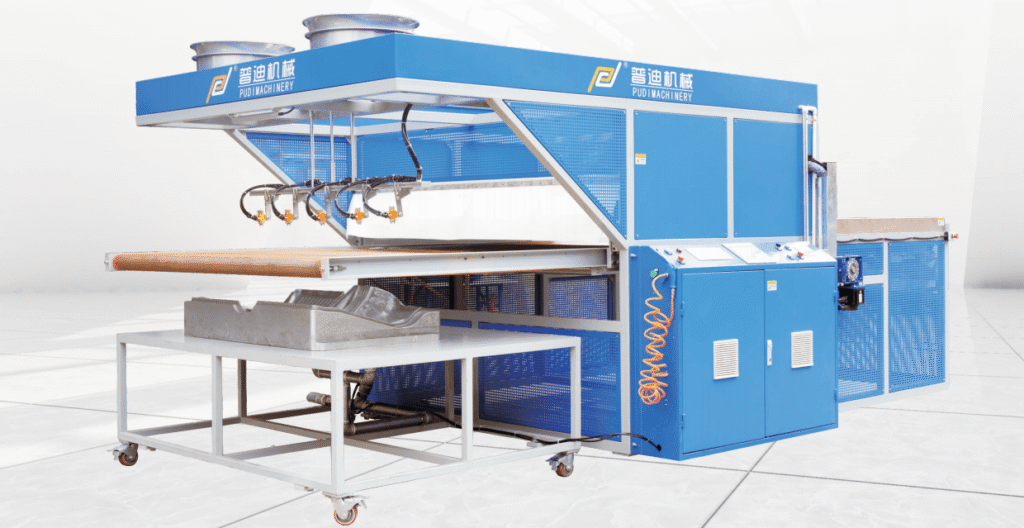
A vacuum forming machine is a type of thermoforming equipment that shapes heated plastic sheets into specific forms using vacuum pressure. In the context of car mat production, it is primarily used to create custom-fit mats with detailed contours that match vehicle floor designs.
The process involves heating a plastic sheet—commonly PVC, TPE, or similar materials—until it becomes pliable. The softened sheet is then placed over a mold, and a vacuum is applied to remove air between the sheet and the mold surface. This pressure difference forces the material to conform precisely to the mold shape.
Vacuum forming is widely used for manufacturing:
- Car floor mats
- Trunk liners
- Interior automotive components
- Protective panels
Its simplicity and efficiency make it a preferred choice for manufacturers aiming for high-volume production.
2. How Vacuum Forming Works for Car Mats
The vacuum forming process consists of several key steps:
2.1. Material Preparation
Plastic sheets are selected based on product requirements. Common materials include:
- PVC (Polyvinyl Chloride): Affordable and widely used
- TPE (Thermoplastic Elastomer): Flexible, durable, and eco-friendly
- Rubber-based composites: Provide enhanced grip and durability
The thickness of the sheet typically ranges from 2 mm to 5 mm, depending on the desired strength and flexibility.
2.2. Heating Stage
The plastic sheet is clamped into a frame and heated using infrared or ceramic heaters. The temperature is carefully controlled to ensure uniform softening without degrading the material.
2.3. Forming Stage
Once heated, the sheet is moved over a mold. A vacuum pump removes air between the sheet and the mold, causing the material to tightly conform to the mold’s surface. This step determines the final shape and detail of the car mat.
2.4. Cooling Stage
After forming, the material is cooled using air or water cooling systems. Cooling solidifies the shape and ensures dimensional stability.
2.5. Trimming and Finishing
Excess material is trimmed using cutting machines or CNC routers. Edges are smoothed, and additional processes such as embossing or logo printing may be applied.
3. Key Components of a Vacuum Forming Machine
A modern vacuum forming machine for car mats consists of several critical components:
3.1. Heating System
The heating system ensures uniform temperature distribution across the plastic sheet. Advanced machines use multi-zone heating to control different areas independently, improving forming precision.
3.2. Vacuum System
The vacuum pump is responsible for creating negative pressure. High-performance pumps ensure fast and consistent forming, especially for complex mold designs.
3.3. Clamping Frame
This component holds the plastic sheet securely during heating and forming. Strong clamping prevents material sagging or misalignment.
3.4. Mold (Tooling)
Molds are typically made from aluminum or steel and define the final shape of the car mat. High-quality molds are essential for achieving detailed textures and precise dimensions.
3.5. Control System
Modern machines are equipped with PLC (Programmable Logic Controller) systems and touch-screen interfaces. These allow operators to control temperature, vacuum pressure, and cycle time with precision.
3.6. Cooling System
Efficient cooling systems reduce cycle time and improve productivity. They also help maintain consistent product quality.
4. Types of Vacuum Forming Machines for Car Mats
4.1. Manual Vacuum Forming Machines
These machines require significant operator involvement. They are suitable for small-scale production or prototyping but are less efficient for mass manufacturing.
4.2. Semi-Automatic Machines
Semi-automatic machines automate key processes such as heating and vacuum application while still requiring manual loading and unloading. They offer a balance between cost and productivity.
4.3. Fully Automatic Machines
Fully automated systems handle the entire process, including feeding, forming, cutting, and stacking. These machines are ideal for large-scale production and offer the highest efficiency and consistency.
5. Advantages of Vacuum Forming for Car Mats
Vacuum forming offers several advantages compared to other manufacturing methods:
5.1. Cost Efficiency
Vacuum forming machines are generally less expensive than injection molding systems. Tooling costs are also lower, making it an attractive option for manufacturers with limited budgets.
5.2. High Production Speed
Short cycle times enable high-volume production. This is particularly important for meeting market demand.
5.3. Design Flexibility
Manufacturers can easily modify molds to produce different designs, allowing customization for various vehicle models.
5.4. Material Efficiency
The process generates minimal waste, as excess material can often be recycled.
5.5. Lightweight Products
Vacuum-formed car mats are lightweight yet durable, improving handling and reducing shipping costs.
6. Cost Analysis of Vacuum Forming Machines
Understanding the cost structure is essential for investment decisions.
6.1. Machine Cost
- Manual machines: $8,000–$20,000
- Semi-automatic machines: $20,000–$60,000
- Fully automatic production lines: $60,000–$150,000+
6.2. Mold Cost
Molds can range from $2,000 to $20,000 depending on complexity and material.
6.3. Operating Costs
Key operating costs include:
- Raw materials: 40–60% of total cost
- Labor: varies by automation level
- Energy: moderate compared to injection molding
- Maintenance: typically 5–10% of machine cost annually
6.4. Cost per Unit
The cost per car mat can range from $1.5 to $5 depending on material, design, and production scale.
7. Integration into Car Mat Production Lines
A vacuum forming machine is typically part of a larger production line that includes:
- Sheet extrusion or material supply systems
- Trimming and cutting machines
- Embossing or printing units
- Quality inspection stations
- Packaging systems
Automation of the entire line improves efficiency and reduces labor costs.
8. Maintenance and Operational Best Practices
Proper maintenance ensures long-term performance and reliability:
- Regular cleaning of heating elements
- Inspection of vacuum pumps and seals
- Lubrication of moving parts
- Calibration of control systems
- Replacement of worn components
Training operators is equally important to prevent errors and maximize productivity.
9. Applications Beyond Car Mats
While primarily used for car mats, vacuum forming machines are versatile and can produce:
- Automotive interior panels
- Packaging trays
- Industrial containers
- Appliance housings
This versatility increases the return on investment for manufacturers.
10. Future Trends in Vacuum Forming Technology
The industry is evolving with new innovations:
10.1. Automation and Robotics
Robotic systems are being integrated for material handling and trimming, reducing labor costs.
10.2. Energy Efficiency
New machines are designed to consume less energy, lowering operating costs and environmental impact.
10.3. Smart Manufacturing
IoT-enabled machines allow real-time monitoring and predictive maintenance, improving efficiency.
10.4. Sustainable Materials
The use of recyclable and biodegradable materials is increasing, driven by environmental regulations and consumer demand.
11. Choosing the Right Vacuum Forming Machine
When selecting a machine, manufacturers should consider:
- Production volume requirements
- Material compatibility
- Automation level
- Available factory space
- Budget constraints
- After-sales support and service
A well-chosen machine can significantly impact production efficiency and profitability.
12. Conclusion
Vacuum forming machines play a critical role in modern car mat manufacturing. They offer a cost-effective, flexible, and efficient solution for producing high-quality automotive mats at scale. By understanding the technology, cost structure, and operational requirements, manufacturers can make informed decisions that enhance productivity and profitability.
As the automotive industry continues to grow, the demand for durable, customizable, and eco-friendly car mats will increase. Vacuum forming technology, with its adaptability and efficiency, is well-positioned to meet these evolving needs.
Investing in the right vacuum forming machine, combined with proper maintenance and optimized production processes, can provide a strong competitive advantage in the global market.
